An NFL cap charge is not the cash earned in a season by a player. A cap charge is based on the following formula:
Money that will be earned + money that has been earned (part of the prorated bonus(es)) + money projected to be earned
Any projected money earned that is incorrect is corrected during an adjustment period the following season, and a new projection is made for the player based on the previous season.
For instance, if a player has a workout bonus of $50k, and a per-game active roster bonus of $1.7 million ($100k per game), and he was active for all 17 games the previous season, that’s a total adjustable charge of $1.75 million.
Let’s say the player in question doesn’t participate in the offseason program, and is inactive for three games in the season, the team is charged $1.75 million for that player. The team would get a credit to their overall cap of $350k.
The following season, that players adjustable charge would be $1.45 million, because workout bonuses are always LTBE. If the player were to miss the offseason program again, but he’s active in all 17 games, the team would lose $250k in cap space the following season ($50k credit for the missed workout, and a debit of $300k for the games active).
The same applies to incentives as far as how they are accounted for each season.
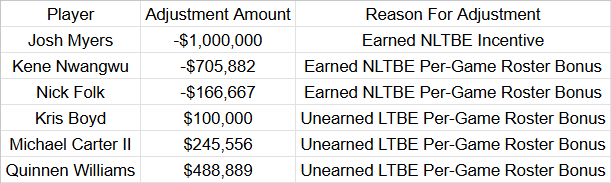
This list outlines the projected adjustments for the Jets in 2026