

When the offseason comes, the New York Jets need to offer the free agent to be what I would consider the ultimate long-term prove-it deal.
In a previous article, I discussed signing Malik Willis to a short-term deal to serve as the bridge quarterback.
Jets Should Hedge Bets with Quarterback Room in 2026

The New York Jets signed Hendon Hooker to the practice squad, which gives the Jets an opportunity to take advantage of a rule in 2026, if they were so inclined.
What if they hedged their bets with a draft pick, signing Hendon Hooker as a short-term backup, who could turn into a starting option later, and Willis as the long-term shot in the dark instead?
Remember, NFL contracts are not necessarily about the total value, but how they’re structured. Well, the Jets could do a contract that allows Willis to be a bridge quarterback while also giving him a chance to earn a long-term deal.
Let’s look at the deal I would propose.
Financial terms: 9 years, $297 million
Cash Breakdown
2026
Base Salary: $1.215 million
Signing Bonus: $6.785 million
2027
Base Salary: $1.26 million
Roster Bonus: $8.74 million (paid on the fifth day of the league year)
2028
Base Salary: $1.305
Option Bonus: $28.695 million
2029
Base Salary: $1.435 million
Option Bonus: $33.565 million
2030
Base Salary: $1.48 million
Option Bonus: $38.520 million
2031
Base Salary: $35.5 million
Roster Bonus: $5 million
2032
Base Salary: $35.5 million
Roster Bonus: $5 million
2033
Base Salary: $40 million
Roster Bonus: $5 million
2034
Base Salary: $43 million
Roster Bonus: $5 million
Most, if not all, of you would scoff at a long-term deal for that amount of money for Willis, because he’s got no true experience as a starter. However, the exact terms are as follows:
Fully Guaranteed Money: 2026 at signing, 2027 on the fifth day of the league year, 2028-30 on the fifth day of the 2028 waiver period
Injury Guarantee: 2027 at signing, 2028-30 on the fifth day of 2027
Here’s how it would look on paper:
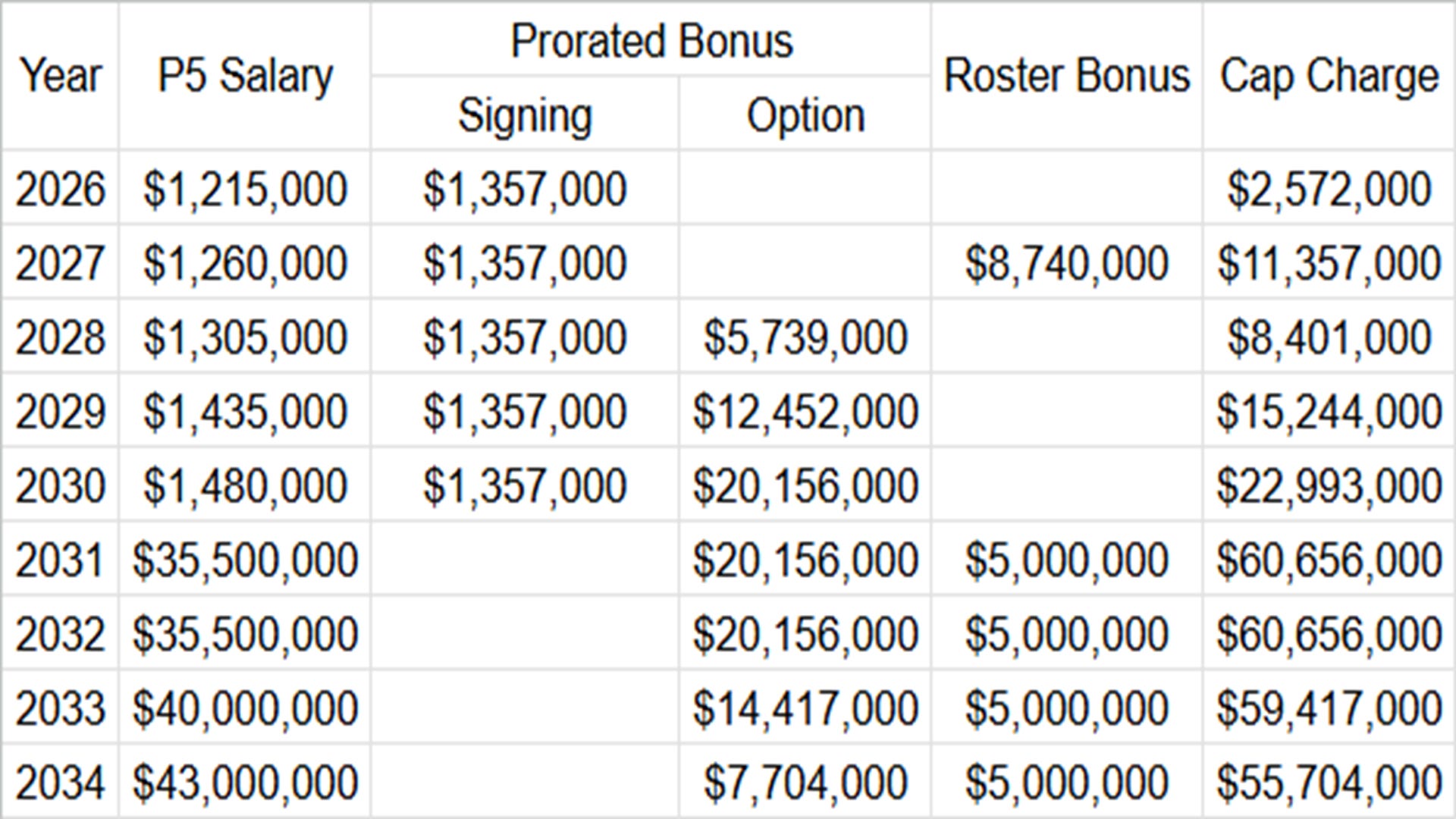
Essentially, the triple option bonus — starting in 2028 — would lock Willis to the Jets for four years — five years, if the Jets don’t want to absorb a large dead cap charge.
Dead Cap Charges (Cap Savings)
2031: $62,433,000 (-$1,873,000)
2032: $42,277,000 ($18,379,000)
2033: $22,121,000 ($37,296,000)
2034: $7,704,000 ($48,000,000)
By 2031, the cap could also be around $500 million anyway. If it’s $500 million, the cap charge for Willis wouldn’t be too prohibitive if he’s still playing well. That would depend on the new CBA at that point, though.
In this “long-term” deal, there’s a prove-it window of two years, while still having the long-term deal in place the team can exercise. It also gives Willis good value based on the likelihood of where he’s at in the QB pecking order at the time of signing. The APY would rank him just below Baker Mayfield at the moment, and that’s right where he should be.
In addition, this contract lasts through his age 35 season. So, it’s security for the future as well. It’s a win-win contract for all.